Publishers who print outside
Your titles, your paper, and the printers and binders you send them to.

Titles and editions, print runs, paper, presses, printers, binders, agents and dispatch. Tathven Agentic ERP runs a publishing house and a printing press the way they really work, with an AI assistant that knows your books, both the ones on the shelf and the ones in the ledger.

Tathven Agentic ERP grew out of a working publishing house that has printed and dispatched books and journals for decades.
Your titles, your paper, and the printers and binders you send them to.
Some titles on your own machines, others sent outside, and the costs of both kept apart.
Estimate a job, quote it, schedule the machines, buy the paper, print, and bill print as a service at the right GST rate.
A reprint, a revised edition and last year’s edition share one title and one code. Spreadsheets add the stock together, the wrong edition gets dispatched, and nobody knows what an old edition is still worth.
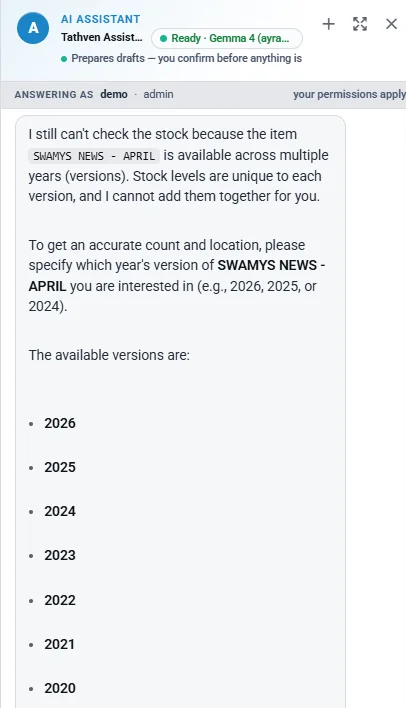
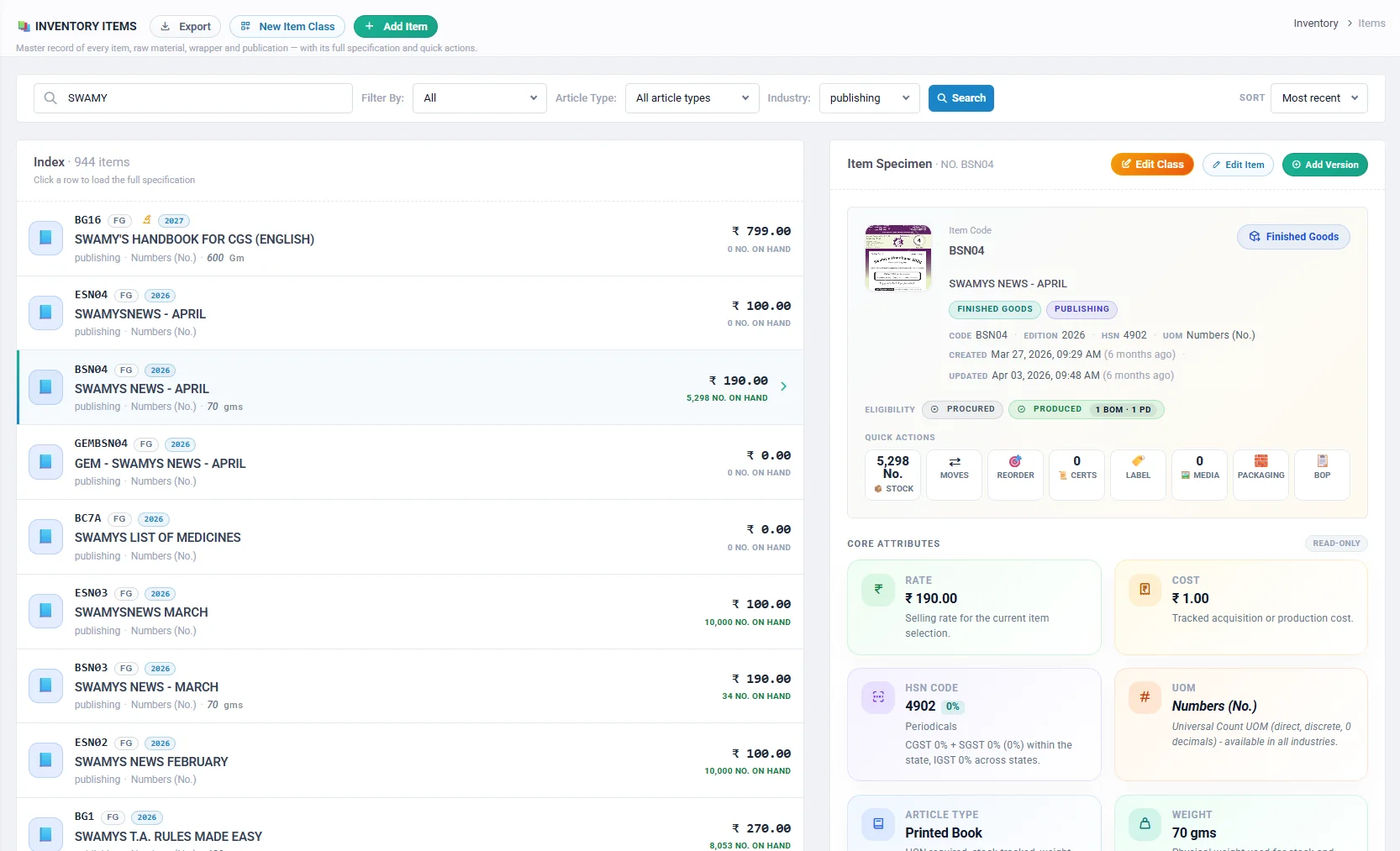
A title keeps one code, and each edition is a version under it, with its own stock, cost, MRP and ISBN. Stock is never added up across editions, so the warehouse picks the edition the order asked for. The item screen carries the publisher’s fields: author, ISBN, pages, edition, release date, synopsis, pre-order date, issue month for periodicals, and the press specification (paper size and quality, pages per form, copies printed, last printed).
Ask “how many copies of the 5th edition are in the main godown?” and the assistant answers from the stock of that edition, not the title’s total.
Paper is the biggest cost and the longest lead time. Buy too much and capital sits in the godown; buy too little and a reprint stops.
Material planning works out what each print run needs, and proposes the purchase and the reprint for you to confirm. Paper is counted the way a press counts it: reams, sheets and forms convert by themselves. Reorder suggestions and a scheduled “what to order” mail reach the buyer before stock runs short. Fast-moving titles are classed A automatically, so counting and buying start with what matters most. Stock is held by godown and bin, with stock-takes and variance reports.
Ask “what should I reorder this week?” and the assistant lists the reorder suggestions. Then it prepares the purchase order for you to confirm.
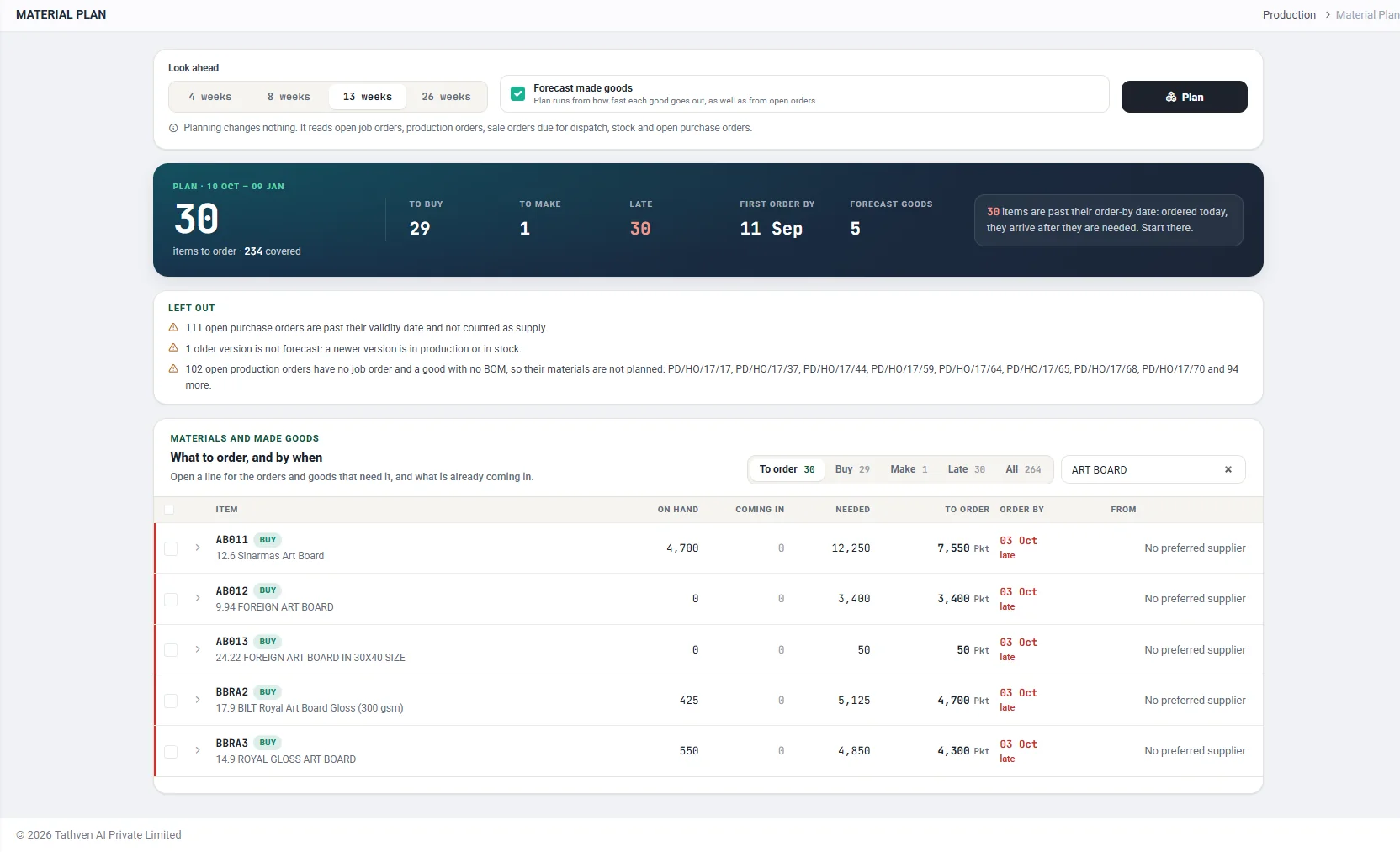
Agents buy on credit, retail buyers must pay first, schools want a quotation and government orders come through GeM. Each discount is negotiated separately, and a parcel leaves before anyone checks the money.
Every buyer has one record with its own type, credit days and credit limit. An order is cleared for dispatch only when it is paid, unless the buyer is an agent, a government buyer or a customer on credit terms and the order is within those terms. Discount schemes are set once and attached to the buyer. Quotations carry an expiry date and become orders in one click, and government orders come in through the GeM connector.
Ask “which agents are over their credit limit?” before you release the next order.
Hundreds of small parcels go out by India Post or courier, bulk orders by lorry or rail, and a customer’s “where is my book?” means digging through registers.
Each dispatch mode is set up once, including India Post, courier, lorry, rail and electronic delivery for e-books. A carrier dispatch cannot be saved without its tracking number, and packing slips are printed for postal bundles. A returned parcel is recorded as a return, not a cancellation, so stock and accounts stay right.
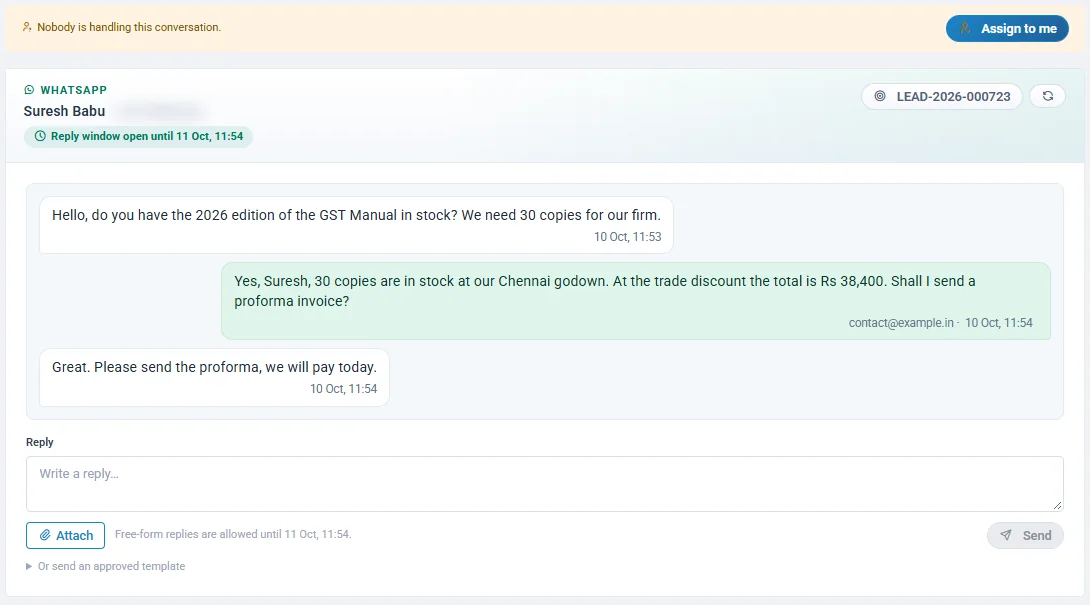
A customer’s WhatsApp message lands in the CRM inbox against their record, so the answer to “where is my book?” is one click away.
Printed books and journals are exempt, while printing services, paper and ink are taxed at different rates. A wrong HSN or a manual GST return is a notice waiting to happen.
Tathven ships with a publishing HSN catalogue:
GST returns (GSTR-1, GSTR-3B and the annual return) are built from the tax ledger, not typed in. Purchases are reconciled against GSTR-2B, and a filed month is frozen.
When a new item has no HSN, the assistant suggests one from the catalogue for you to confirm.
A book’s cost depends on forms, reams, plates, cover board, binding and wastage at every step. Every reprint is costed again on a calculator, and the cover price is a gut feeling.
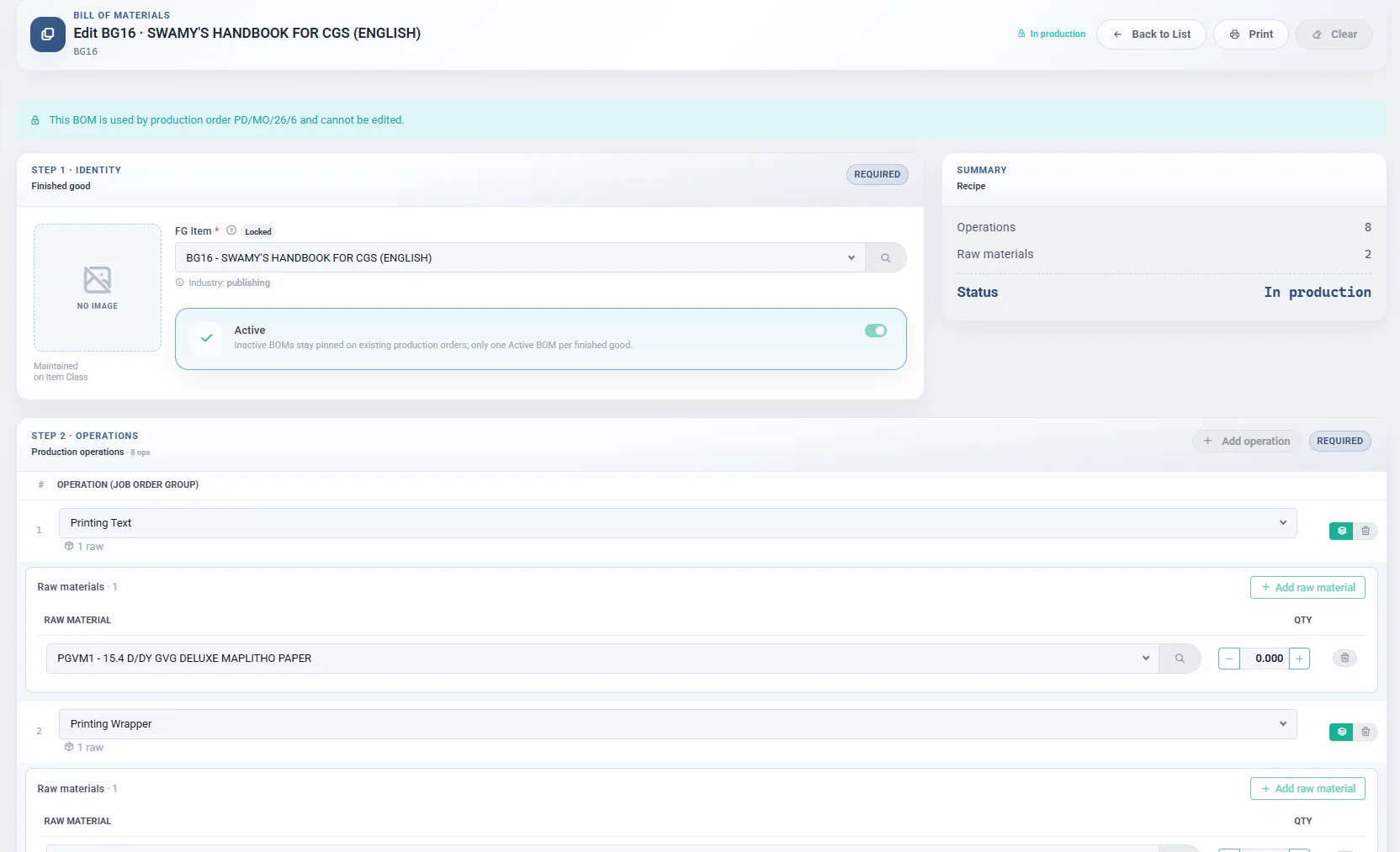
Each book has a bill of materials that speaks print: body paper, wrapper, end paper and inserts, plus plate making, printing, sewing, binding and lamination. Tathven converts pages to forms, forms to sheets and sheets to reams for you. Job rates and wastage are kept per operation. A costing order works out the cost of the run, with your overhead, and suggests a sale price. Once approved, it sets the item’s cost and price.
Ask “what will 2,000 copies of this title cost?” and the assistant reads the bill of materials and the latest costing. It moves the costing through approval when you confirm.
Paper, board and printing rates change every few months. The cost sheet on file is a year old, and titles quietly start selling below cost.
The cost-drift view compares each title’s costed price with today’s rates and shows which titles a price change has pushed out of line, by how much, so you re-cost the ones that matter.
Ask “which titles did the paper price rise hit?” and the assistant answers from the cost-drift figures.
Plates made once are reused across reprints, and one make-ready serves several forms. Charge it all to the first run and that run looks expensive; forget it and every reprint looks cheap.
A shared step, such as plates used across several runs, is costed at its share, one Nth to each run, so every run carries a fair part of the set-up.
The run used more paper than planned, the binder charged more, and the difference disappears into the month’s accounts. Nobody learns from it.
Paper and materials are issued against the production or job order, and work in progress is valued as the order moves. When the order is closed, anything left over is written to a production variance account, not hidden in stock. Scrap and spoiled sheets are recorded as scrap, and rejects on a run are recorded with the run.
Paper, board and covers go out to a printer and the books come back from a binder. What was sent, used, wasted and still owed lives in a register and in somebody’s memory, and the printer’s bill arrives with nothing to check it against.
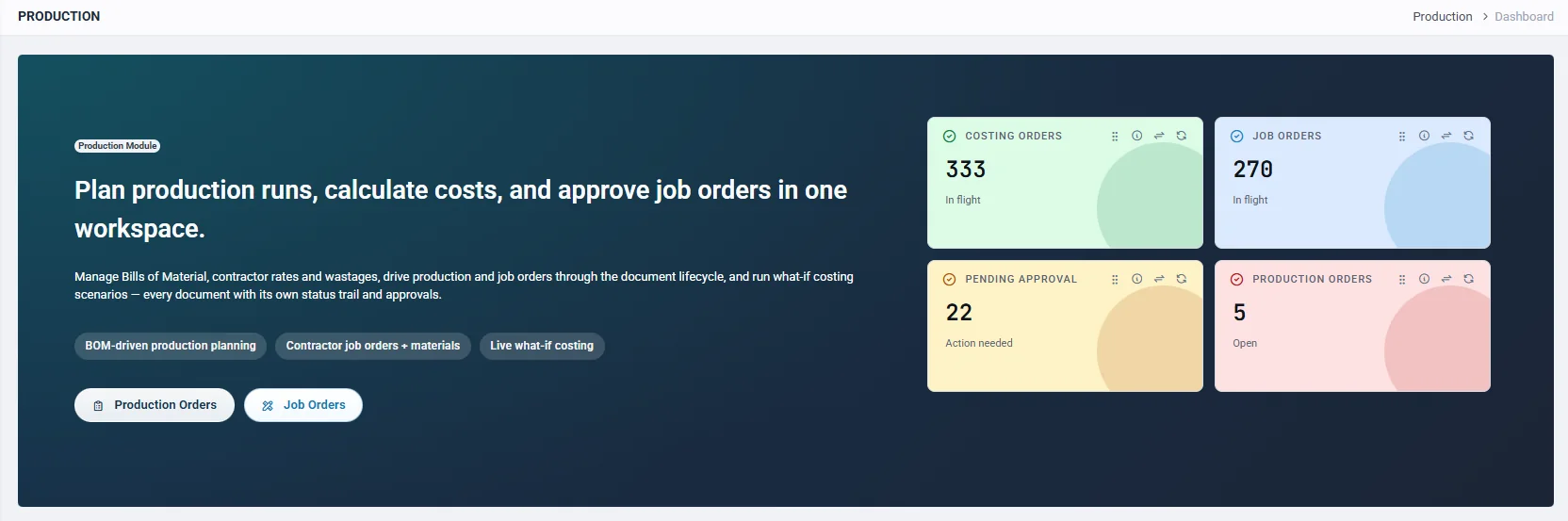
A job order sends the work to an outside printer or binder, or to your own press. Material is issued against the job order and the unused balance comes back against it. The finished copies are received, and the job-work bill is checked against the job order. GST’s ITC-04 return for material sent to job workers is built from the same records.
Ask “which job orders are still open with the binder?” The assistant moves a job order through approval when you confirm.
A publisher with its own press still sends the overflow outside. The two costs mix in the books, so nobody can say whether the press is cheaper than the printer down the road.
Each job order is marked as done in-house or by a contractor. A contractor’s bill and your own press’s conversion cost post to separate accounts, so the two can be compared title by title.
Machines, make-ready and binding all compete for the same week. The schedule lives on a whiteboard, and a rush order upsets everything without anyone seeing what slips.
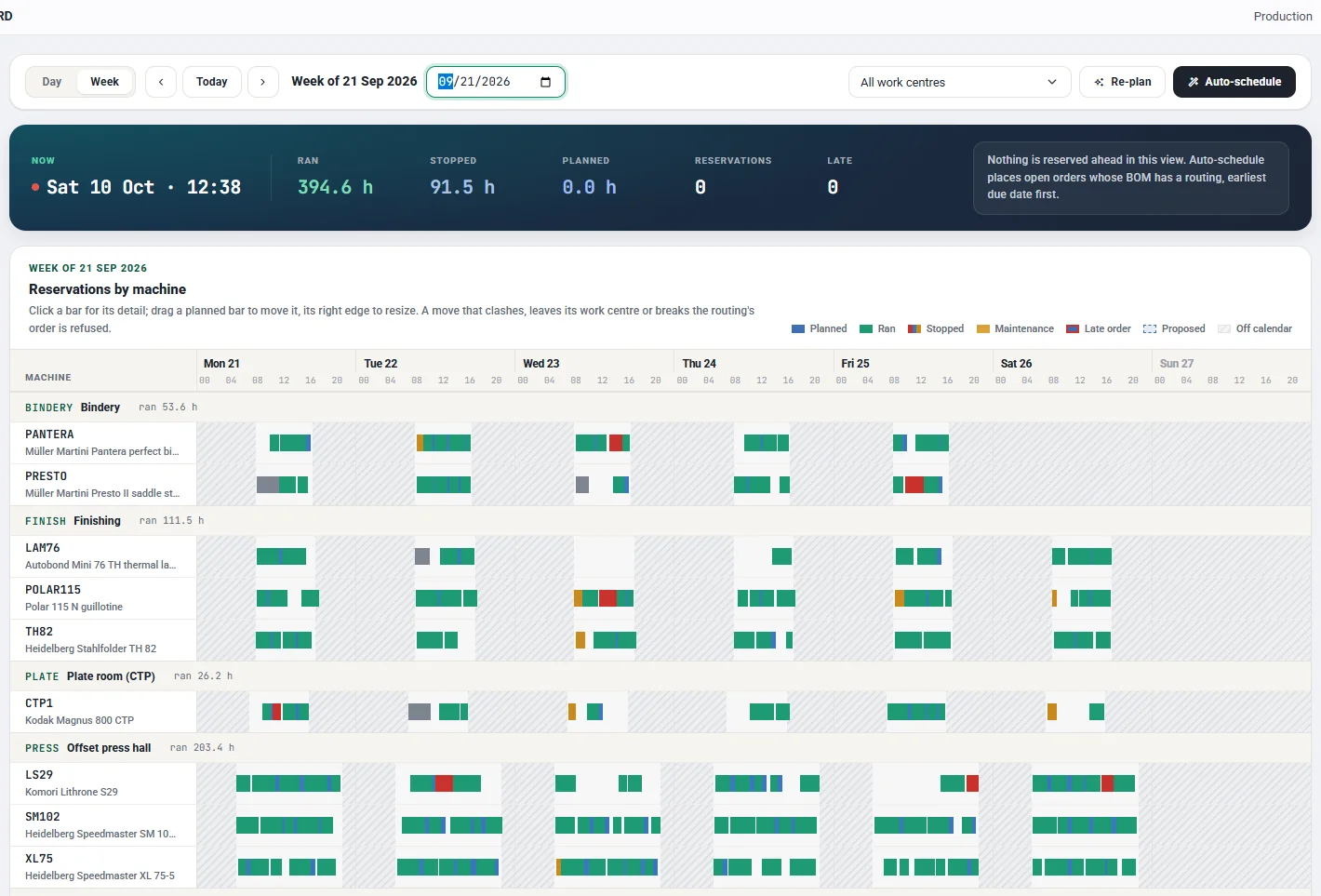
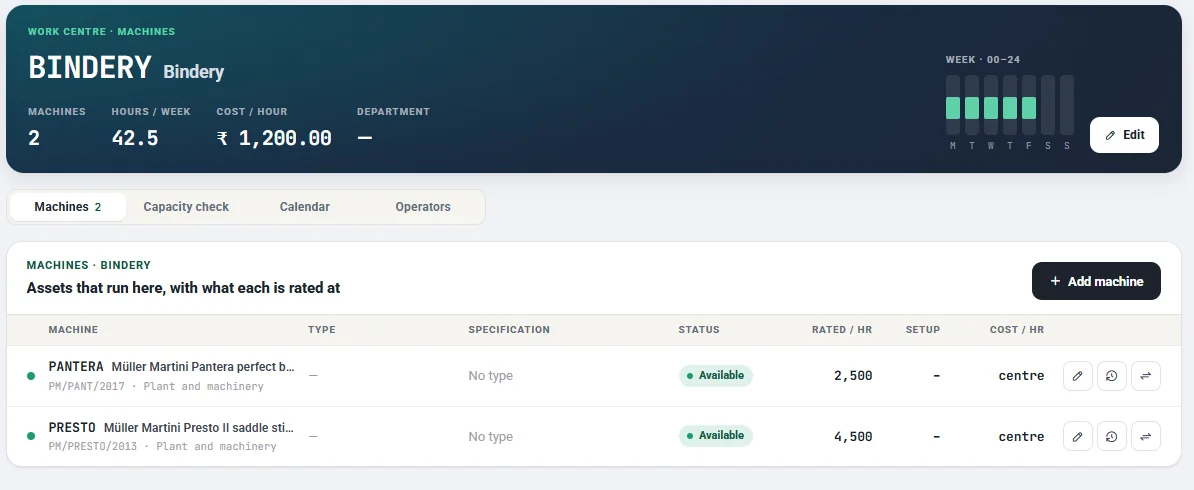
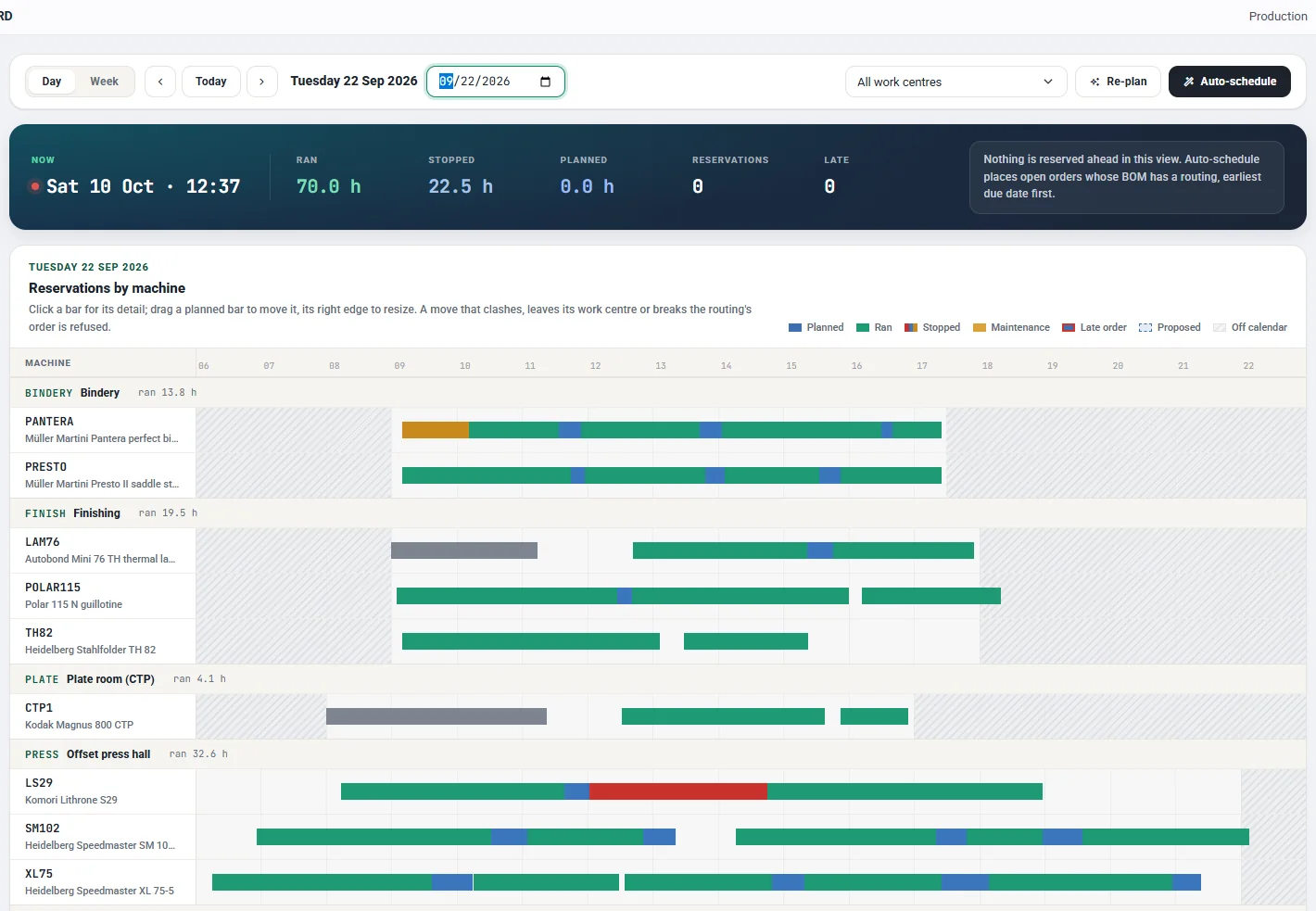
Each press, folder and binding line is a work centre with its own machine-hour rate, working calendar and maintenance plan. Production orders are scheduled on a board against what each machine can actually do. A machine due for maintenance is flagged, and a daily mail lists the maintenance that is due or overdue.
Ask “which production orders are running late, and why?” or “which press is free for a 10,000-copy run?” The assistant reads the schedule and the machines. It then prepares the schedule, a reschedule or extra overtime hours, and nothing changes until you confirm.
Operators start and stop jobs on paper, downtime is never written down, and the office learns about a breakdown or a spoiled run a day later.
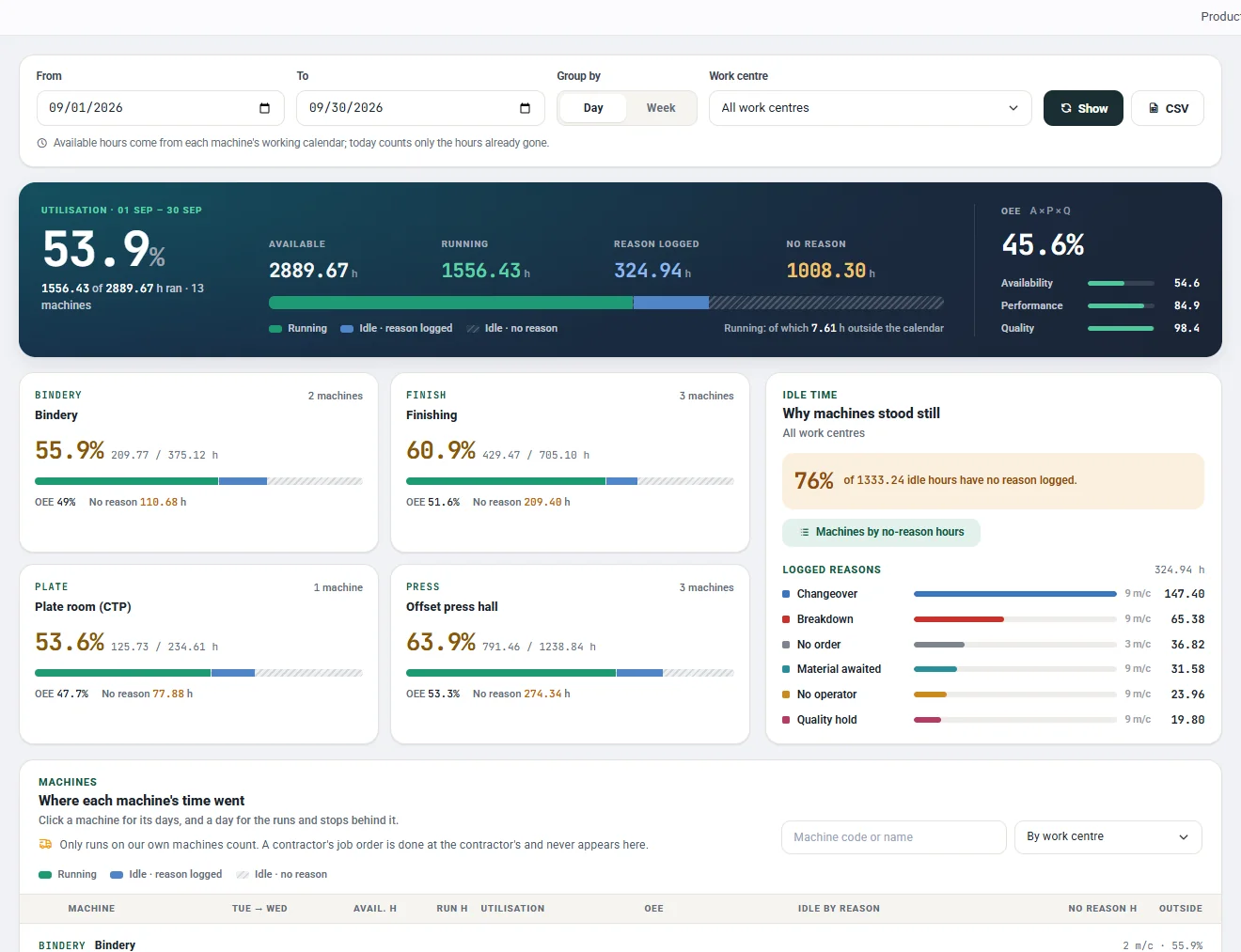
The shop floor screen starts, pauses and stops each run, with rejects and downtime recorded as they happen. Utilisation and OEE show how much of each machine’s time went into good copies. Each work centre has its own operator pool, with skills and leave. Overtime is added as extra hours on the machine’s calendar, so a late shift is planned, not improvised.
Ask “what is on the shop floor right now?”, “how much downtime did the four-colour press have this month?” or “what is our utilisation by machine?”
A client wants a price for a book, a calendar or a run of cartons by this evening. The estimate is built on a calculator from paper rates, plates and machine time, and two estimators give two different numbers.
The same costing order works for a client’s job: paper by the ream, plates, machine-hour rates, job rates and wastage per operation, and your overhead, all from your own rates, so every estimator gets the same number. The quotation goes out with an expiry date and becomes an order in one click.
Printing is a service, not stock. Book printing, commercial printing and cartons each carry a different GST rate, and the invoice has to say so.
Print services are set up as service items with their SAC codes:
A service line on a sale order is billed without touching stock, and the tax comes from the code.
A press runs on its machines, its paper and its operators, and each lives in a different book.
Everything in “Production” and “Costing” above applies to a press:
Every question needs a report, and every report needs the one person who knows how to run it.
Ask Tathven’s AI assistant in plain language. It answers from your own data, within your own access rights:
It can also do the work:
Each of these comes as a card you check and confirm. Nothing is posted until you do.
Accounts, stock, production, sales and HR in separate software means retyping, mismatched numbers and month-end reconciliations.
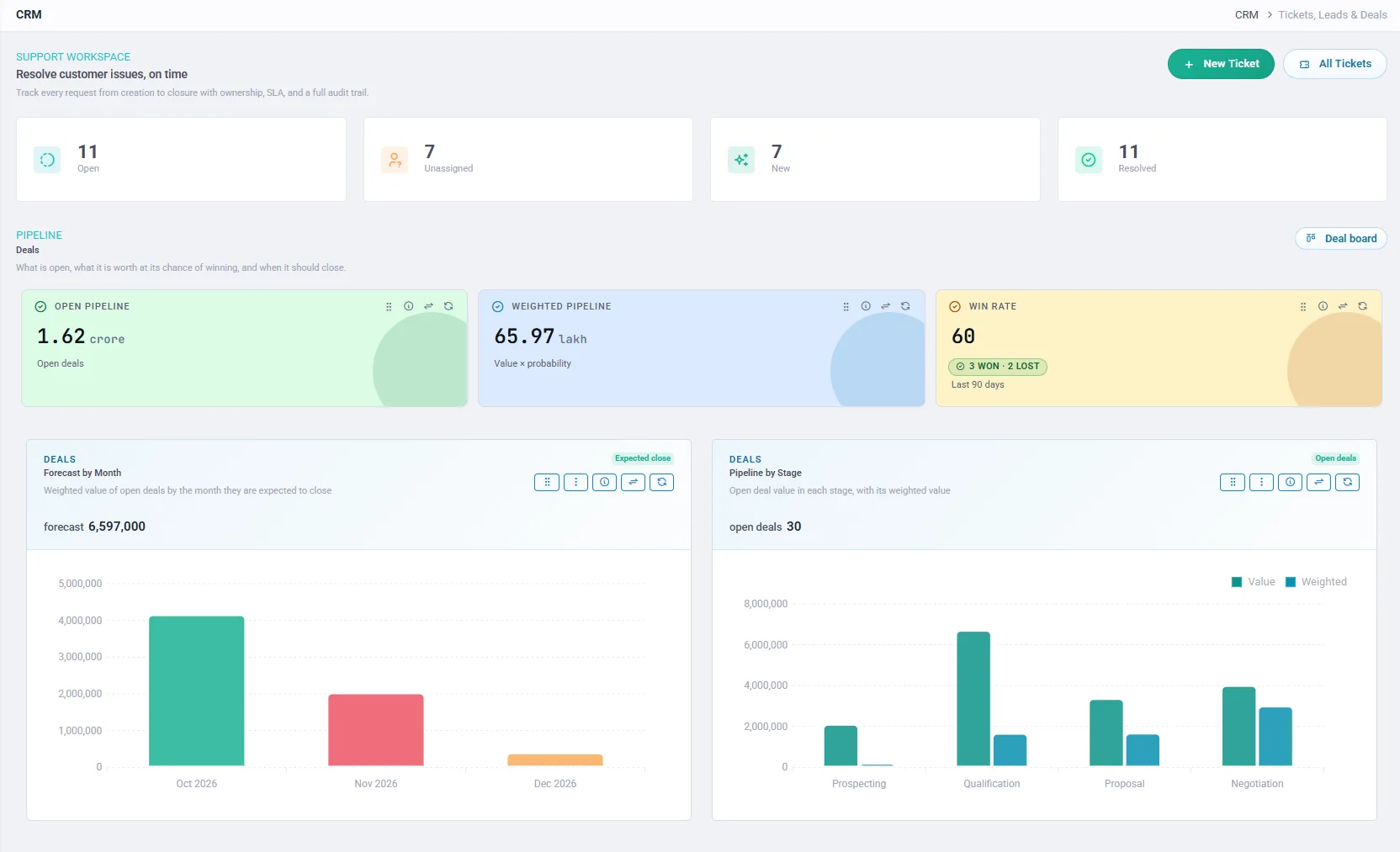
Stock, production, sales and finance are one system, and every stock movement reaches the books by itself. Tathven HRMS shares its people and holidays with production planning. Tathven AI Workspaces keeps contracts, artwork and documents beside the records they belong to. The CRM keeps each lead, enquiry and WhatsApp conversation with the customer it belongs to, and can sort and draft replies to support tickets for your team to send.
One code per title, stock and cost per edition, ISBN, author, press specs, barcode labels.
Cost per run from forms, reams, plates, machine hours and wastage, shared set-up costs, suggested sale price, cost drift.
Print-aware bills of materials, production orders, job orders in-house or outside, material issue and return, work in progress, production variance.
Work centres with machine-hour rates, scheduling board, shop floor runs, downtime, utilisation and OEE, maintenance plans.
Reams and sheets, material planning, reorder suggestions, godowns and bins, stock-takes, lots.
Quotations, orders, print services, agents and government buyers on credit terms, discount schemes, GeM.
India Post, courier, lorry and rail, tracking numbers, packing slips, returns.
Publishing HSN and SAC catalogue, GST returns from the ledger, GSTR-2B reconcile, ITC-04, full accounts.
An assistant that answers from your data and prepares the next step for you to confirm.
ERP, HRMS, AI Workspaces and CRM with a single sign-in.
Bring your titles, your presses, your printers and your agents. Tathven Agentic ERP brings the rest. Choose Books, Inventory or Manufacturing, and grow without changing systems.