PCB assemblers and EMS providers
SMT and through-hole assembly, for their own products or for brands.

Components by lot and date code, SMT lines on a schedule, solder defects on record, serial numbers on every unit and the cost of every build. Tathven Agentic ERP runs an electronics or electrical assembler in one system.
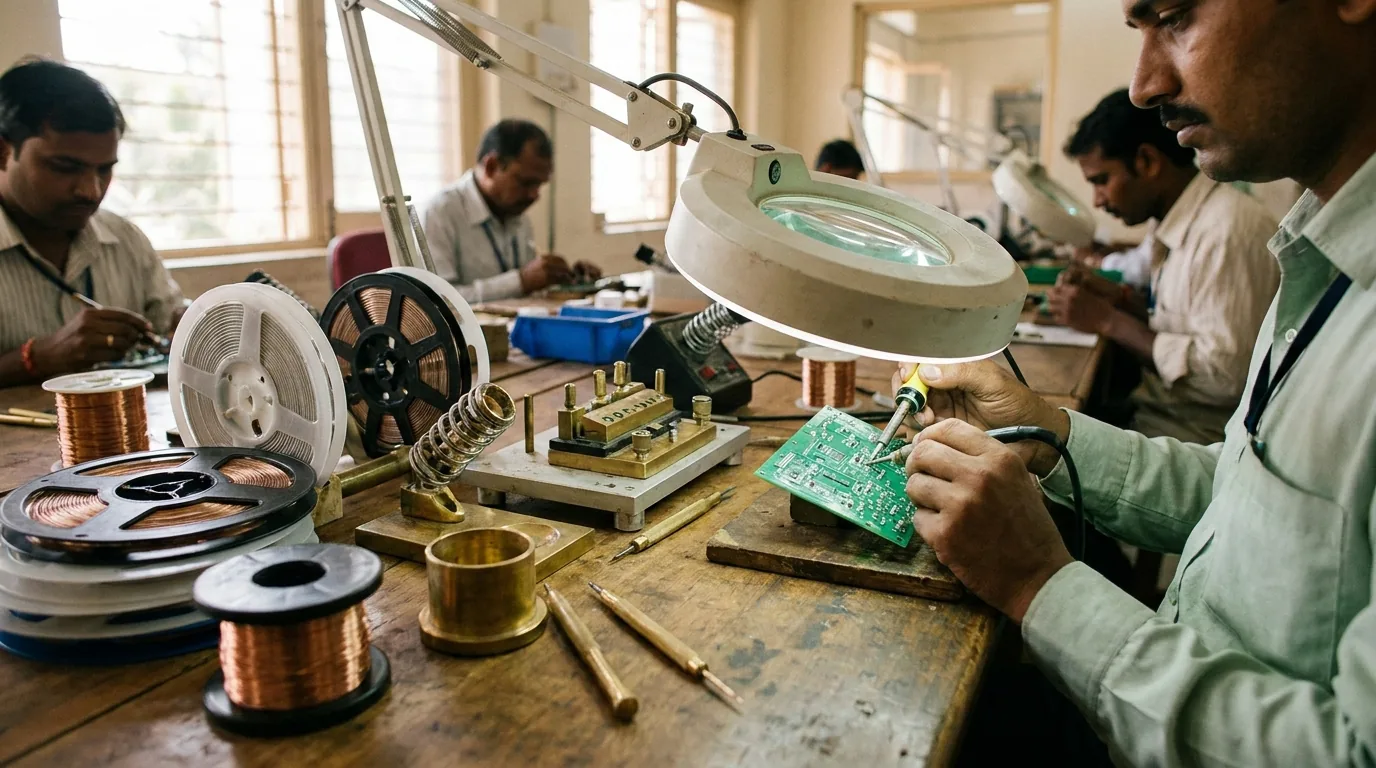
SMT and through-hole assembly, for their own products or for brands.
Switches, control panels, power supplies, lighting and wiring harnesses.
Boards, cables and enclosures put together, tested and packed.
Hundreds of components go into one board. One is short, and the line stops.
Material planning explodes open orders through their bills of materials, nets every component against stock and open purchases, and proposes purchase and production orders for you to confirm. Components are kitted against the job order before the build starts.
Ask “which components are short for next week’s builds?” and the assistant prepares the purchase order for you to confirm.
A reel with the wrong part number, or packing that has taken in moisture, reaches the line.
Components can be held on receipt until a person with the clearance right releases them. A ready receipt specification checks the part number and manufacturer against the order, the date code, the moisture-barrier packing, the measured value and solderability. Lots are traced from receipt to the boards they went into, and items are scanned by barcode on receipt and issue.
Lines are booked by memory, feeder setups eat the day, and nobody sees which order slips.
Pick-and-place machines, reflow ovens, wave soldering, solder paste printers and optical inspection come as ready machine types, each with its own fields. Each machine sits in a work centre with its calendar and machine-hour rate. Production orders are scheduled on a board against what each machine can do, and auto-schedule places open orders by due date.
Ask “which builds are running late, and why?” The assistant prepares a reschedule or extra overtime for you to confirm.
The line stops for a reflow fault, a feeder setup or a missing component, and the reason is never recorded.
The shop floor screen records each run with good and rejected quantities and the reason for every stop. Downtime reasons come ready for electronics: SMT line breakdown, reflow oven fault, feeder setup, component shortage, stencil cleaning and ESD audit hold. Utilisation and OEE show how much of the line’s time made good boards.
Dry joints and bridges are reworked at the bench, and nobody knows which board or line causes them.
Rejects on a run name their defect: dry or cold solder joint, solder bridge, missing component, wrong polarity, wrong component fitted or functional test failure. A defect report raised from the run carries the root cause and corrective and preventive actions, and a Pareto view shows which defects, items and work centres lead. A complaint from a customer can raise a defect report too.
In-circuit and functional test results are written on sheets, and a unit leaves without its hi-pot test.
Ready specifications check an assembled board (workmanship to IPC-A-610 class 2, in-circuit test, supply current, firmware version, coating thickness) and a finished product (functional test, hi-pot, insulation resistance, serial number range, rating plate and burn-in hours). Each operation can also carry its own in-process checks, and a run cannot be stopped while a required check is outstanding.
A unit fails in the field and nobody can say when it was made or what went into it.
Items can be serial-tracked, one serial per unit, and duplicates are refused. Finished lots are linked to the component lots they used, and the recall view traces a lot to every customer and parcel.
A customer wants a price for a new board today.
A costing order works out the cost from components, machine hours, job rates, wastage and overhead, and suggests a sale price. The cost-drift view shows which products have moved away from their standard.
Boards go out for coating or testing, and what came back lives in challans.
A job order sends the work to a contractor with material issued against it and a due-back date, unused material comes back to stores, and GST’s ITC-04 return is built from the same records.
Goods leave before anyone checks the money, and returns are typed by hand.
Every buyer has its own credit days and limit, and an order is cleared for dispatch only when it is paid or within credit terms. An HSN catalogue for printed circuits, integrated circuits, LEDs, switches, cable, converters and control panels comes ready. GST returns are built from the tax ledger.
Lots and date codes, receipt holds and release, barcode scanning, kitting.
Pick-and-place, reflow, wave, paste printer and inspection machine types, calendars, machine-hour rates.
Finite-capacity board, auto-schedule, drag to reschedule.
Runs, rejects by defect, electronics downtime reasons, utilisation and OEE.
Solder defect types, in-process checks, board and product release specifications, CAPA.
Serial numbers, finished lots linked to component lots, recall to customer.
Costing orders, cost drift, contractor job orders, ITC-04.
An assistant that reads the floor and prepares the next step for you to confirm.
Bring your bills of materials, your line and your customers. Tathven Agentic ERP brings the rest, on the Manufacturing plan with the electronics catalogue.