Injection and blow moulders
Caps, closures, containers, bottles and moulded parts.

Polymer and masterbatch by lot, moulding machines on a schedule, short shots and flash on record, and the reason every press stood idle. Tathven Agentic ERP runs a moulder, extruder or packaging converter in one system.
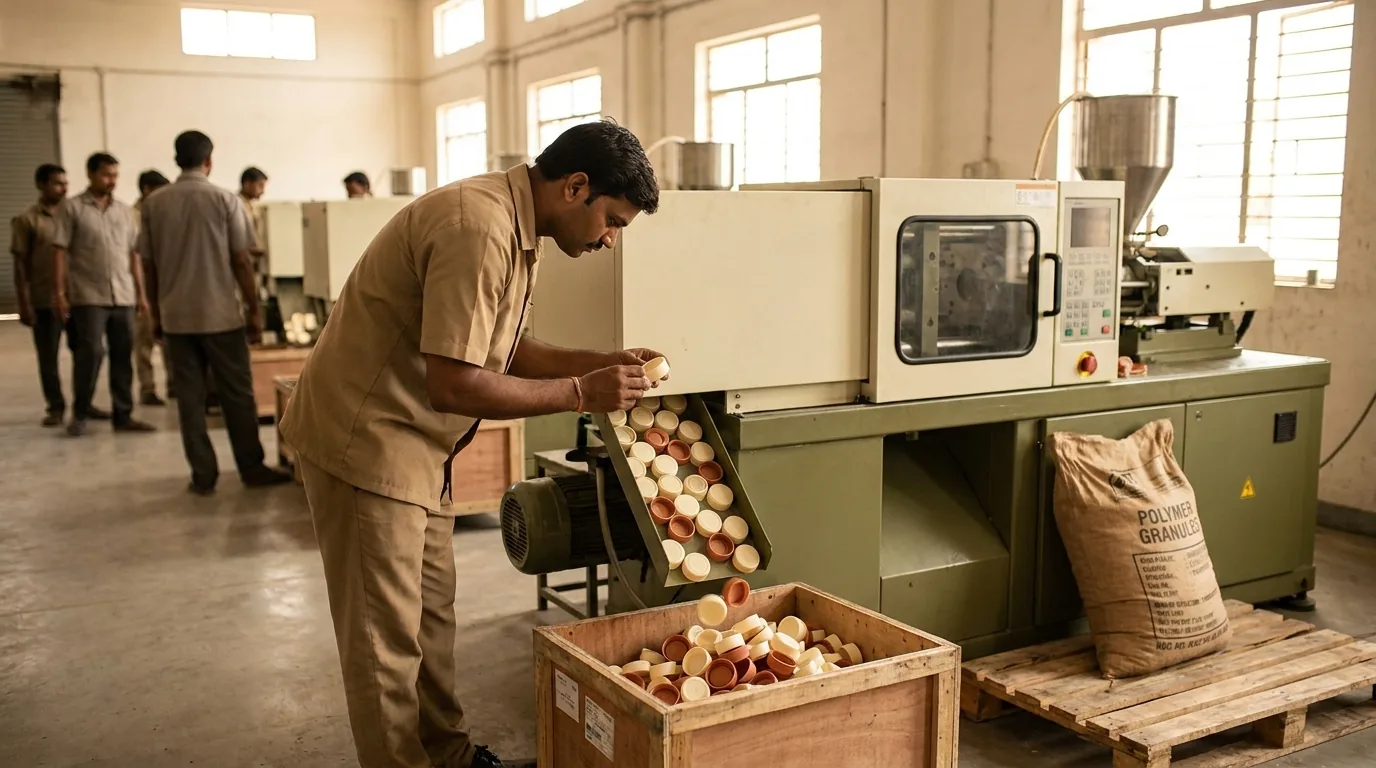
Caps, closures, containers, bottles and moulded parts.
Pipe, profile, film, sheet and flexible laminates.
Trays and cups, and moulding for other brands.
A polymer lot with the wrong melt flow or too much moisture reaches the press, and a whole shift of parts is scrap.
Polymer and masterbatch can be held on receipt until a person with the clearance right releases them. Ready receipt specifications check the grade against the order, the melt flow index, moisture and contamination for polymer, and colour, let-down ratio and dispersion for masterbatch. Every reading is judged against its limits and the lot is traced from then on.
A grade runs out and the press stops, while another grade sits in the store for months.
Material planning works out what open orders need, by kilogram, against stock and open purchases, and proposes purchase and production orders for you to confirm. Reorder suggestions reach the buyer in time.
Ask “what polymer should I order this week?” and the assistant prepares the purchase order for you to confirm.
Presses are booked on a whiteboard. A mould change upsets the week and nobody sees what slips.
Injection, blow moulding, extrusion, thermoforming and granulating machines come as ready machine types, with their own fields such as clamping force, shot weight, cavities and output. Each machine sits in a work centre with its calendar and machine-hour rate. Production orders are scheduled on a board against what each machine can do, and auto-schedule places open orders by due date.
Ask “which orders are running late, and why?” The assistant prepares a reschedule or extra overtime for you to confirm.
A press stands idle for a mould change, a colour purge or a hopper dryer fault, and the reason is never written down.
The shop floor screen records each run with good and rejected quantities and the reason for every stop. Downtime reasons come ready for plastics: machine breakdown, mould repair, hopper dryer fault, mould change, colour purge and polymer awaited. Utilisation and OEE show how much of each press’s time made good parts.
Ask “how much time did we lose to mould changes this month?”
The same defect returns every week, and nobody knows which mould or machine causes it.
Rejects on a run name their defect: short shot, flash, sink mark, warpage, black specks or a weak weld line. A defect report raised from the run carries the root cause and corrective and preventive actions, and a Pareto view shows which defects, items and work centres lead. A ready release specification checks part weight, a critical dimension, moulding defects, colour and fit before a lot is released.
Resin drying, moulding, printing, welding and packing are done by habit, and the cost of each step is unknown.
Operations come ready for plastics: resin drying, injection and blow moulding, extrusion, thermoforming, pad and screen printing, regrinding, assembly and welding, bagging and boxing, with mould maintenance as an overhead. Each product’s bill of materials and routing use them, with the wastage you expect at each step.
Polymer prices move every month, and the cost on file is out of date.
A costing order works out the cost from polymer, masterbatch, machine hours, wastage and overhead, and suggests a sale price. The cost-drift view shows which parts have moved away from their standard cost.
Ask “which products has cost drift flagged?”
Parts go out for printing or assembly, and what came back lives in challans.
A job order sends the work to a contractor with material issued against it and a due-back date, unused material comes back to stores, and GST’s ITC-04 return is built from the same records.
Customers buy on credit, and returns are typed by hand.
Every buyer has its own credit days and limit, and an order is cleared for dispatch only when it is paid or within credit terms. An HSN catalogue for polymers, tubes, film and sheet, bottles, bags, closures, moulded parts and moulds comes ready. GST returns are built from the tax ledger, and purchases are reconciled against GSTR-2B.
Polymer and masterbatch by lot, receipt holds and release, ready receipt specifications.
Injection, blow moulding, extrusion, thermoforming and granulator types, calendars, machine-hour rates.
Finite-capacity board, auto-schedule, drag to reschedule.
Runs, rejects by defect, plastics downtime reasons, utilisation and OEE.
Moulding defect types, defect reports with CAPA, Pareto, release specifications.
Ready plastics operations, routings, costing orders, cost drift.
Credit terms, plastics HSN catalogue, GST returns from the ledger.
An assistant that reads the floor and prepares the next step for you to confirm.
Bring your presses, your moulds and your polymer. Tathven Agentic ERP brings the rest, on the Manufacturing plan with the plastics catalogue.